
Lactic vs. Glycolic vs. Salicylic
If you've ever stared at a skincare label wondering whether to pick lactic acid or glycolic acid—or if you can use them together—this guide breaks down exactly what each acid does, who it's for, and how to use it safely.
First: What Are Exfoliating Acids?
Unlike scrubs, which use physical particles to remove dead skin, acids do the job chemically—gently loosening the bonds between dead skin cells so they can shed naturally. This smooths texture, evens tone, and boosts skin renewal. The right acid can treat anything from dullness to acne to fine lines.
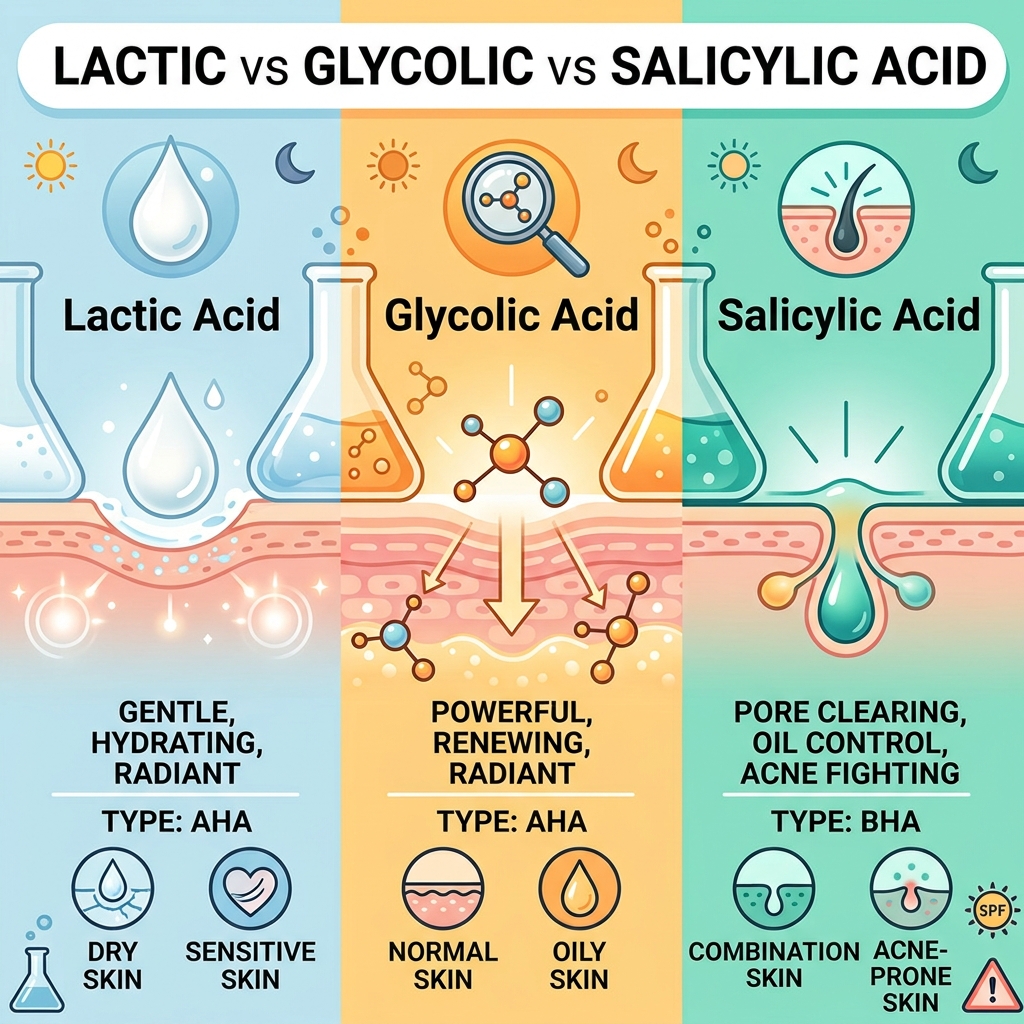
1. Lactic Acid (AHA) – Gentle, Hydrating, Brightening
Best for: Dry, sensitive, or textured skin
Think: Glowy, hydrated, smoother skin
Lactic acid is an AHA (alpha hydroxy acid) that works on the skin's surface. It exfoliates while pulling in moisture, so it's ideal if you want brighter skin without irritation. It's also amazing for smoothing rough patches and treating keratosis pilaris ("chicken skin").
Try it if you want to:
- Fade dark spots
- Hydrate and exfoliate in one step
- Improve texture without drying out
Recommended Products:
- 12% Lactic Acid Exfoliant – Effective yet gentle enough for regular use.
- Chocolate Face Mask with Lactic Acid – A soothing, nourishing mask that exfoliates and hydrates with the added indulgence of cocoa.
2. Glycolic Acid (AHA) – Powerful, Resurfacing, Radiance-Boosting
Best for: Normal to oily skin, early signs of aging
Think: Deep exfoliation, glow-up results
Glycolic acid is also an AHA but has a smaller molecule than lactic acid, meaning it penetrates deeper. It's great for tackling fine lines, dullness, and uneven skin tone—but it's stronger, so you'll want to ease in.
Try it if you want to:
- Treat pigmentation or sun damage
- Smooth fine lines
- Get that fresh, "glass skin" look
Recommended Products:
- 10% Glycolic Acid Toner – Balanced with aloe and hyaluronic acid
- 30% Glycolic Acid Peel – High strength, ideal for experienced users
3. Salicylic Acid (BHA) – Pore-Clearing, Oil-Busting, Acne-Fighting
Best for: Oily, acne-prone, or combination skin
Think: Clearer skin, fewer breakouts, tighter pores
Salicylic acid is a BHA (beta hydroxy acid) that goes deep into pores to dissolve oil and dead skin. It's a go-to for acne, blackheads, and shiny T-zones. Unlike AHAs, it's oil-soluble, which makes it effective inside the pores.
Try it if you want to:
- Prevent or treat breakouts
- Minimize clogged pores and blackheads
- Balance oily skin without over-drying
Recommended Product: Salicylic Acid Toner 2% – Lightweight and refreshing with aloe, witch hazel, and peppermint.
So, Which One Should You Use?
| Skin Concern | Best Acid | Why |
|---|---|---|
| Dull, dry, textured | Lactic Acid | Gentle, hydrating, smooths without irritation |
| Fine lines, pigmentation | Glycolic Acid | Deep penetration, boosts collagen, fades dark spots |
| Acne, blackheads, oily | Salicylic Acid | Oil-soluble, clears pores, reduces breakouts |
Can You Use Lactic Acid and Glycolic Acid Together?
While it's technically possible, we don't recommend layering multiple acids in the same routine—especially if you're new to exfoliation. This can lead to irritation, redness, and a compromised skin barrier.
Better approach: Use one acid in the morning and another at night, or alternate days. For example, lactic acid on Monday/Wednesday/Friday, glycolic acid on Tuesday/Thursday.
Exception: Salicylic acid (BHA) can sometimes be used with AHAs, but only if your skin is well-tolerant and you introduce them slowly.
When Should You Use Exfoliating Acids?
Best time: Evening. Acids can make your skin more sensitive to sunlight, so it's safer to use them at night.
Frequency: Start with 1–2 times per week. If your skin tolerates it well, you can increase to 3–4 times per week—but daily use is rarely necessary and can lead to over-exfoliation.
When Will You See Results?
- Lactic Acid: 1–2 weeks for smoother texture, 4–6 weeks for brighter tone
- Glycolic Acid: 2–4 weeks for glow, 6–8 weeks for fine lines and pigmentation
- Salicylic Acid: 1–2 weeks for fewer breakouts, 4 weeks for clearer pores
Note: Results vary based on concentration, skin type, and consistency of use.
Signs You're Over-Exfoliating:
- Redness or irritation that doesn't go away
- Stinging or burning when applying products
- Dry, flaky patches
- Increased breakouts (purging is normal for 2–4 weeks, but prolonged breakouts are not)
- Shiny but tight skin (sign of compromised barrier)
What to do: Stop using acids for 1–2 weeks, focus on hydration and barrier repair (ceramides, hyaluronic acid, squalane), then reintroduce slowly.
Who Should Avoid Exfoliating Acids?
Consult a dermatologist before using acids if you:
- Are pregnant or breastfeeding (especially for high-strength glycolic acid)
- Have eczema, rosacea, or severely sensitive skin
- Are using prescription retinoids (like tretinoin)
- Have recently had chemical peels, laser treatments, or microneedling
- Have sunburned or broken skin
Pro Tips for Using Acids:
- Start slow. Once or twice a week, then increase as your skin adjusts.
- Don't mix them. Avoid layering acids or combining with physical scrubs—this can irritate your skin.
- Use sunscreen. Acids make your skin more sensitive to the sun. Always protect your glow.
Frequently Asked Questions
Q: What's the difference between lactic acid and glycolic acid?
A: Lactic acid is gentler and hydrates while exfoliating, making it ideal for dry or sensitive skin. Glycolic acid penetrates deeper for stronger resurfacing results.
Q: Can I use multiple acids at once?
A: It's best to stick with one exfoliating acid at a time to avoid irritation. Rotate based on your skin's needs.
Q: How often should I use exfoliating acids?
A: Start 1–2 times per week and adjust depending on how your skin reacts. Always listen to your skin.
Q: Can I use lactic acid and glycolic acid together?
A: We don't recommend layering multiple acids in the same routine. Instead, alternate days or use one in the morning and another at night.
Q: When will I see results from exfoliating acids?
A: Lactic acid shows results in 1–2 weeks (texture) to 4–6 weeks (brightness). Glycolic acid takes 2–4 weeks (glow) to 6–8 weeks (fine lines). Salicylic acid works in 1–2 weeks (breakouts) to 4 weeks (clearer pores).
Q: Can I use exfoliating acids if I have sensitive skin?
A: Yes, but start with lactic acid (the gentlest AHA) and patch test first. Use once a week initially and always follow with a hydrating moisturizer.
Q: Do I need to use sunscreen if I use acids at night?
A: Yes. Acids increase sun sensitivity even if used at night. Always apply SPF 30+ during the day.
Q: What are signs of over-exfoliation?
A: Redness, stinging, dry patches, increased breakouts, or shiny-but-tight skin. If you notice these, stop using acids for 1–2 weeks and focus on hydration.