
Physical vs Chemical Sunscreen: Which Is Actually Safer for Sensitive Skin?
If you've ever applied sunscreen and felt burning, stinging, or itching—you're not alone. When I started making skincare, sunscreen was one of the hardest things to get right, especially for people with sensitive skin. So many commercial options left my skin irritated, greasy, or worse: broke me out.
That's when I learned the real difference between physical (mineral) and chemical sunscreens—and why zinc oxide became the only UV filter I trust on my own face.
If you've ever had a bad reaction to SPF, or you're wondering whether chemical sunscreen is safe, this guide breaks down exactly what you need to know.
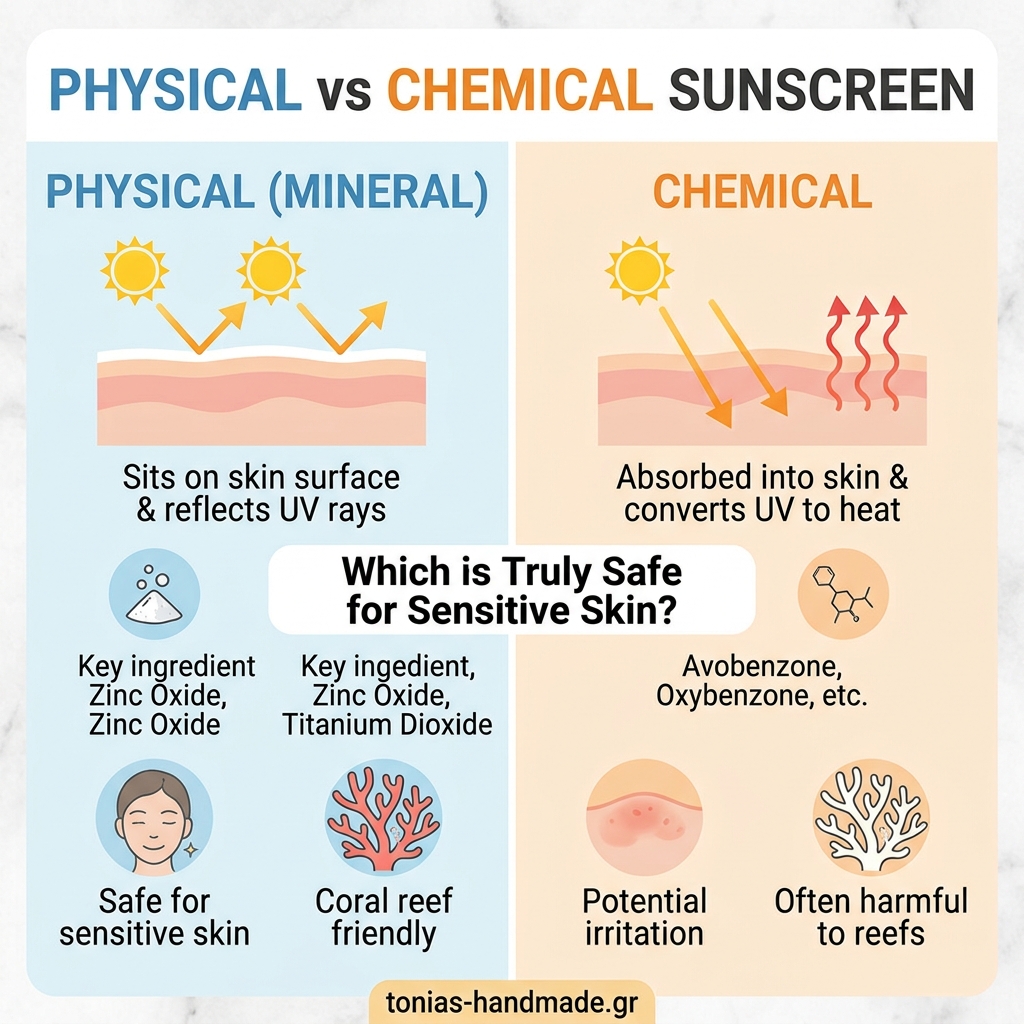
What's the Difference Between Physical and Chemical Sunscreen?
Here's the short version:
| Physical (Mineral) | Chemical | |
|---|---|---|
| How it works | Sits on top of skin and reflects UV rays | Absorbs into skin and converts UV rays to heat |
| Main ingredients | Zinc oxide, titanium dioxide | Avobenzone, oxybenzone, octinoxate, homosalate |
| Irritation risk | Very low (sits on surface) | Higher (absorbs into skin) |
| Safe for sensitive skin? | Yes—dermatologist recommended | Often not—can cause stinging, redness |
| Environmental impact | Reef-safe (zinc oxide is non-toxic to coral) | Often not—oxybenzone and octinoxate harm reefs |
| White cast? | Sometimes (depends on formula) | No—clear finish |
| Protection type | Zinc oxide = full UVA + UVB protection | Varies—often needs multiple filters for full coverage |
| Best for | Sensitive, acne-prone, rosacea, eczema, reactive skin | Normal, non-reactive skin (if tolerated well) |
Why I Only Use Zinc Oxide on My Skin
Zinc oxide is what I personally use and trust on my own face. It's the only UV filter that protects from both UVA and UVB rays on its own, it doesn't clog pores, and it's naturally calming. That makes it ideal for anyone with:
- Rosacea—zinc oxide reduces redness and inflammation
- Eczema—gentle enough for compromised skin barriers
- Acne-prone or oily skin—non-comedogenic, won't clog pores
- Reactive skin—doesn't sting or burn on application
- Post-procedure skin—dermatologists recommend it after lasers, peels, or microneedling
Unlike chemical filters, zinc oxide doesn't sink into your skin—it forms a protective barrier on top. That's why it's recommended for babies, post-laser treatments, and people recovering from burns. It's gentle and effective.
Why I Avoid Chemical Sunscreens (Even the "Good" Ones)
Many drugstore sunscreens use ingredients like oxybenzone and octinoxate, which:
- Can cause irritation, stinging, and allergic reactions
- Have been banned in Hawaii, Key West, and parts of Mexico for being harmful to coral reefs
- May disrupt hormones (oxybenzone has been detected in breast milk and urine)
- Often contain fragrance, alcohols, and silicones that leave skin feeling tight, itchy, or greasy
Even "clean" chemical sunscreens can be problematic for sensitive skin because the filters themselves (like avobenzone) can cause reactions when they absorb into the skin.
I don't want that on my face—or yours. That's why I left all of it out.
But What About the White Cast?
Let's talk about it—because yes, some mineral sunscreens leave a ghostly film. But it doesn't have to be that way.
Here's what matters:
- Micronized vs non-micronized: Micronized zinc oxide has smaller particles that blend better into the skin without compromising safety.
- Non-nano is key: Nano particles are so small they can potentially enter the bloodstream. I use non-nano micronized zinc oxide—safe, effective, and minimal white cast.
- Formula matters: A well-formulated mineral sunscreen with emollients (like carrot seed oil, sweet almond oil) will blend smoothly without looking chalky.
My SPF goes on easily, doesn't pill, doesn't sting, and won't leave you looking like a ghost.
SPF 30 vs SPF 50: Why I Chose 30
I also chose to stop at SPF 30, and here's why:
- Higher zinc = more white cast: To get SPF 50 with zinc oxide alone, you need 25%+ zinc, which leaves a noticeable white film and makes the product harder to spread.
- SPF 30 is enough: SPF 30 blocks 97% of UVB rays. SPF 50 blocks 98%. That 1% difference isn't worth the trade-off in texture and wearability.
- Most people underapply: Studies show most people apply only 25–50% of the recommended amount. A smooth, spreadable SPF 30 that you'll actually use generously offers better real-world protection than a thick, chalky SPF 50 you skimp on.
Bottom line: The best sunscreen is the one you'll use every day, in the right amount.
How I Formulated My SPF for Sensitive Skin
When I made my Organic SPF 30 Sunscreen, I built it with every sensitive-skin issue in mind:
- Micronized non-nano zinc oxide for safe, effective broad-spectrum protection
- Hyaluronic acid for hydration without greasiness
- Carrot seed and sweet almond oil for nourishment and smooth application
- No fragrance, no alcohol, no pore-clogging fillers
- No oxybenzone, octinoxate, or chemical filters
It goes on easily, doesn't pill under makeup, doesn't sting sensitive skin, and won't leave you looking like a ghost.
Final Thoughts (From Someone Who's Tried It All)
If your skin reacts to sunscreen, you're not alone. I made this formula because I needed it myself—something clean, gentle, and truly protective.
You deserve sunscreen that feels good and does its job.
Try my Organic SPF 30 with Zinc Oxide for face
and Organic Waterproof Sunscreen SPF 30 with Zinc Oxide for body
– made fresh to order, for people who care what goes on their skin.
Frequently Asked Questions
Q: What's the main difference between physical and chemical sunscreens?
A: Physical sunscreens use minerals like zinc oxide or titanium dioxide to sit on top of skin and reflect UV rays. Chemical sunscreens absorb into skin and convert UV rays into heat, which is then released.
Q: Is physical sunscreen better for sensitive skin?
A: Yes. Physical sunscreens are less likely to cause irritation because they sit on top of the skin instead of absorbing into it. Zinc oxide is also naturally calming and anti-inflammatory.
Q: Can I wear physical sunscreen under makeup?
A: Absolutely. Choose a lightweight, non-greasy formula to avoid pilling or heaviness under makeup. Let it set for 1–2 minutes before applying foundation.
Q: Does physical sunscreen leave a white cast?
A: Sometimes. However, modern formulas with micronized non-nano zinc oxide reduce the white cast and blend more easily into the skin. The key is a well-formulated product with emollients.
Q: How often should I reapply sunscreen during the day?
A: Reapply every 2 hours, especially if you are outdoors, sweating, or swimming, regardless of whether you use physical or chemical sunscreen.
Q: Is chemical sunscreen safe?
A: Chemical sunscreens are FDA-approved, but some filters (like oxybenzone) have raised concerns about hormone disruption and environmental impact. For sensitive skin, physical sunscreens with zinc oxide are generally safer and less irritating.
Q: Can I use physical sunscreen on my body?
A: Yes! Physical sunscreens work on both face and body. For body, you may want a lighter, more spreadable formula (like our Waterproof SPF 30) to cover larger areas easily.
Q: Does zinc oxide protect against UVA and UVB?
A: Yes. Zinc oxide is one of the few single ingredients that provides broad-spectrum protection against both UVA (aging) and UVB (burning) rays.